Friday, 4 August 2017

Stranger in a strange land - derealisation and realisation

(Somewhere in England) 

It is possible, for example while commuting to work, to entertain the fantasy that one has just this moment been put into this body going about its business, that one has come from somewhere else (perhaps a previous life which one has forgotten).

Luckily this body knows where it is going, and one knows that if one thought about it one would easily remember details such as what one's job is, one's home situation, loved ones and so on. But for the moment one doesn't pursue those thoughts. Therefore there is no need for any anxiety, yet at the same time one experiences the world as a stranger in a strange land.

The current Wikipedia article describes derealisation as "an alteration in the experience of the external world so that it seems unreal." However what I am describing makes the world seem more real. One realises that most of the time one is preoccupied with some thought or other, barely noticing one's surroundings. As a stranger freshly arrived from somewhere else one notices everything.

A similar phenomenon occurs when driving or walking to a new place. Even if the journey is quite short, it seems long, because one has to notice things in order to find one's way. The same journey when familiar seems short, and one remembers few details. It is possible to drive for an hour on a familiar route in perfect safety and remember nothing.

The Wikipedia article goes on to say that derealisation includes "feeling as though one's environment is lacking in spontaneity, emotional colouring, and depth." However with this experiment the world has more depth and colour, and things are generally brighter. If there is beauty, one notices it, sometimes in unexpected places.

Interestingly the Wikipedia article says that derealisation is related to depersonalisation, which is sense of unreality in one's personal self. There may well be an actual psychiatric or morbid condition characterised by this, but it is also of note that psychologists and philosophers have pointed out that the idea of 'self' itself has an unclear meaning, or even, the 'self' does not exist. Am I the same person I was yesterday? The one who decided to get up as soon as the alarm went off is the same as the one who decided to lie in for an extra 15 minutes instead? But this is a topic for another time.

I went in search of the original quotation, 'stranger in a strange land.' It comes from the King James Bible translation of Exodus 2:22 and is spoken by Moses in exile. I was also led to this excellent poem by Rita Dove. At the beginning of the poem Rita Dove quotes Emily Dickinson: "Life is a spell so exquisite, everything conspires to break it." It is by experiments like the one I describe, and others, that we can try to return to the magic of reality.

Friday, 14 July 2017

The wisdom of a Barbados taxi driver


Our taxi driver on a trip round the island in Barbados was called William. He said William is a good name for a husband, because you always have bills. He said there are people in the world who don't want to be happy. He will have their happiness if they don't want it.

Something unexpected happened to him: one of the passengers on the trip was visually impaired, and required a lot of assistance (although actually the man was pretty independent to have come on the trip on his own in the first place). William said that all difficulties thrown in his path are a test and an opportunity to see how well he will deal with things.

This last idea is the one I like best. If we live in a heartless mechanical universe, then anything that happens outside our expectations is annoying and makes us grumpy and negative. It puts us in a small dark place in our minds. If on the other hand there is some purpose to it all, then we can place ourselves in the hands of that higher power, do our best and be happy.

What if it is all meaningless? Someone once said that the Greeks dreamed the right dream. Since, one way or another, we dream our way through our lives, it is good to dream a dream that works ('a path with heart' as Carlos Castaneda put it). To keep our minds open and in the light. To take challenges with a good attitude. Better still, to dream well and know that we are dreaming.

Attributed to Meher Baba: "Don't worry, be happy, make efforts."

(Note: I have not found the source of this quotation despite an internet search.)

Thursday, 29 June 2017

Uncertainty in economics and in life

"Doubt is not a pleasant condition, but certainty is an absurd one." -- Voltaire, quoted in Mervyn King, The End of Alchemy.

"At the heart of modern macroeconomics is the same illusion that uncertainty can be confined to the mathematical manipulation of known probabilities." -- Mervyn King, ibid. p.121.

As has been argued elsewhere, for example in Taleb's Black Swan and in Mandelbrot et. al. The Misbehaviour of Markets, many market analysts, economists, politicians and others, including probably most of us ordinary folk, imagine that most things stay more-or-less the same most of the time, and when things change they do so within reasonable boundaries. Those of a mathematical persuasion may further imagine that things follow a normal or Gaussian distribution, that is, events are distributed in a bell-curve, in which very few things are extreme and most things are more-or-less average.

This is the case with things like people's height, for example, or fitness, or biological variables (see my earlier blog post about the misuse of this) or workers' incomes (excluding oil billionaires and bank executives). However it is not the case with non-linear dynamic systems.

What, I hear you ask, is a non-linear dynamic system? It is any system in which there is any degree of complexity in the relation between inputs and outputs, and in which the outputs feed back as inputs. An example is the weather and the so-called butterfly effect, in which the flapping of a butterfly's wings can change the course of a tornado several weeks hence. An outcome can be radically changed by a small change in initial conditions. This is why even with much more powerful computers it is unlikely that the weather will be predictable with any accuracy more than ten days ahead, because it is simply not feasible that we could ever measure the initial conditions with sufficient accuracy.

When we come to the stock market there are so many variables and so many unknowns that long-term prediction is impossible. Someone bets on an oil company, then a major accident happens and the stock falls, or else someone announces a major breakthrough in solar power and the stock falls, or there is a war involving a major oil exporter and the price of oil rises. I such cases the unexpected occurs frequently and is better represented by some kind of fat-tailed distribution, in which uncommon events happen more frequently.


There are up-sides and down-sides to this. Our lives in general are subject to the unexpected. We enjoy the stability of relationships and our homes and jobs and we value living in a country that is not at war, if we think about it at all. But the unexpected does happen. We prefer not to think about it, other than the approximately 1 in 14 million chance that our lottery ticket will win.

The up-side of the butterfly effect, though, is that if the beating of the wings of a butterfly in China can change the course of a tornado on the other side of the world, imagine what the effect of a smile could be!

Thursday, 8 June 2017

Obedience

My daughter aged 4 was pinched by another child at nursery. Apparently there was no provocation, and in any case I know my daughter to be a placid and non-aggressive child. One of the nursery teachers told my daughter to pinch back, 'to show him what it's like.' My daughter did as commanded, but with reluctance, and in a way that amounted to a touch rather than a pinch.

In her own way my daughter was resisting the command, or carrying it out under duress and with minimum force. It was the furthest she felt she could go short of open defiance. But clearly she was not happy with what she had been told to do.

On the one hand I felt admiration for her, that a small child already understands what is 'not nice' and has the understanding not to do things that are 'not nice' to others, even if told to by an adult. On the other hand she is at an age at which she has to learn to obey, simply because there are a huge number of aspects of the world that she does not yet understand, and there isn't always time to explain them. 'Stay on the pavement!' must be obeyed sometimes without question. Going to bed at the right time is another thing that has to be done whether the child wants to or not. Without obedience a child may do all manner of things, pulled this way and that by the impulses of the moment, and lack the structure that is necessary for a calm and healthy life.

My preliminary conclusion is that, in the usual order of things, obedience must be learned first and conscientious objection later, even if in the case of the pinching, conscientious objection has begun early. For us as adults also, inner self-control has to be developed as a strong base from which occasional necessary resistance to what is expected of us is possible.

Thursday, 1 June 2017

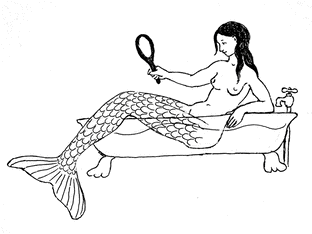
A Mermaid in the Bath is now available in Kindle format!

Well this took a while! There are books out there that tell you that you can convert your word-processor files into e-books in an hour. But it takes a lot longer than that if you care about the look and feel of the result.

While an e-book can never quite match the experience of having a real book in your hands, I have done my best to put into the Kindle version the little images that are scattered between sections of A Mermaid in the Bath, including mermaids, starfish, jellyfish, an evil-looking squid and the wonderful union-jack underpants. The lovely mermaid facing the title page I had to leave out because Amazon charges authors by the kilobyte for the so-called download fee. Even so a smaller version of the sleeping mermaid is still to be found in chapter 44.

Ah me! Because of the download fee I had to reduce all the images to the minimum file size possible without losing too much quality. Current e-readers will not support the 600 dots per inch that print allows in any case. That's why it all took a long time.

Anyway, it's a work of art and it's a bargain at less than the price of a cup of coffee.

Friday, 26 May 2017

I believe in the religion of love


(This Ibn Arabi quotation was found here.)

How can anyone believe in a God of hate? But as Hannah Arendt pointed out, evil is banal. It is a failure to think and to understand. It is the mindless acceptance of whatever rubbish someone else has said, or the mindless misinterpretation of scripture. Think, question, and don't trust your own conclusions.


Thursday, 11 May 2017

Innocent faith

Clever atheists sometimes mock the faith of the faithful. I used to do the same. But there is an obtuseness about the mocking.


If I may plead in my own defence, it was because I was looking for the door and no-one seemed able to show me the door. The myths by which religions live were opaque to me. The myths are the door, but without the key the door is a wall.

Some denied there was a door at all let alone a key. Specifically, in my youth I would ask, 'what is the meaning of life?' and I was told that the question was naive. Probably I'd grow out of it. At the same time I didn't see how the Virgin Birth or even Hanuman and his army of monkeys could help me. Are these not stories for children?

Again, some of the faithful claim that their version of the truth is the only correct one, the only path to Paradise. How should one choose? Choosing on the basis of ones parents' belief seemed to me rather arbitrary. Surely one should choose what is right, not necessarily what is habitual? Given that my revered primary school teacher was a Spiritualist (who believed her dog was the reincarnation of her previous dog, but had the clarity of mind to explain to us children that not everyone believes as she does, and that there are other points of view), my father flit between the Quakers, the Roman Catholic Church and some kind of misunderstanding of Buddhism, and my mother became a born-again atheist, I did not have a clear route to follow.

I cannot resist putting in a little anecdote told to me by a Bahá'í: someone was travelling through some part of the USA and passed a sign saying The Church of God. A little further down the road was another sign, reading The One True Church of God. Later they passed a third sign reading The One and Only True Church of God. Now clearly they cannot all be the only true church, and the philosopher Bertrand Russell would have pointed out that asserting that something is true does not add one iota to its truth value ('P is true' means exactly the same as 'P', where P is a proposition).

There is a problem with belief and it is this: a clever atheist can always come along and point out that parthenogenesis is recorded among some animals but not among humans, or that a reporter from the Daily Mail was not present at the Annunciation (not that that would have made the events any more plausible), or that no-one has ever been seen with blue skin (and I certainly mean no disrespect - dancing with all the cow-girls is one of the most delightful stories in all religion). How do we address this?

It seems to me likely that there is a door and there is a key. I cannot prove this, but without this assumption there is no point in even starting. This assumption has been made by the best minds since the dawn of history and probably before. The world is full of it and civilisations have been built on it. Correctly understood, the similarities between the faiths and the wise are there to see, although clothed in different styles and with different myths. A myth is simply a story, in this context a story that contains a truth. A truth that cannot be expressed better any other way.

Everyone needs a story to live by. Carlos Castaneda refers to 'a path with heart.' As we live and learn, perhaps the way we describe our path becomes less naive, we put away childish things (1 Corinthians 13:11). Meanwhile, a childish faith is a path with heart.

He who mocks the infant's faith
Shall be mock'd in age and death.
He who shall teach the child to doubt
The rotting grave shall ne'er get out.

He who respects the infant's faith
Triumphs over hell and death.
The child's toys and the old man's reasons
Are the fruits of the two seasons.

- William Blake, from Auguries of Innocence