About footnotes*
[* and a man with three testicles]
When I am reading a printed book I actually read the footnotes (and I shall explain why you might also want to). If there are end-notes I keep an extra bookmark in the end-notes section (ok, I'm a geek). But doing this in a Kindle is not easy. This is one reason why e-reader formatting needs to be re-thought.
You may be one of those people who never read footnotes or end-notes, so you will not see a problem here. In a moment I shall try to persuade you otherwise (I shall explain about the man with three testicles and what the Pope did about it). But the main point of this article is to question some of the assumptions about book layout in e-readers. Simply transporting a book text unmodified into an e-reader such as the Kindle does not always translate into a good reader experience. This is particularly the case with footnotes and end-notes.
Footnotes, properly used, are there to enhance the reader experience while not interrupting the flow of text. Uses include explaining an obscure reference or phrase with which the reader might not be familiar, or adding an illuminating anecdote that is not a proper part of the text. In Bailey and Love's
Physical Signs in Clinical Surgery there is a section describing the harmless swelling called a spermatocele that can arise in a man's scrotum. This can resemble a third testicle. That's all you really need to know. But a footnote adds, "The story goes that, in the 14th century, on petition from a patient with a spermatocele, the Pope granted a gentleman to marry two wives because he had three testicles."*
[*Also in Bailey and Love's Short Practice of Surgery p.1383.]
The anecdote is not strictly necessary, but it is memorable. I would point out that Bailey and Love do not reference the source of the anecdote, so they may have made it up or copied it from someone else who made it up. If they had referenced it properly they could have put the reference in with the footnote. Perhaps Dan Brown can go and look for it in the Vatican archives, or perhaps it's just a rumour in Piers Plowman.*
[*I've no idea.]
While I am not aware of any strict rules, it seems to me that end-notes are more appropriate where it is less likely that the reader will want to look them up straight away. For example, there may be repeated quotations from a particular source, and you might want to look up the original for context ("A wonderful evening" - Groucho Marx; original quotation: "I've had a wonderful evening, and this wasn't it"), or because you feel inspired by what has been quoted and you want to go right out and buy the book.
With Kindle books, footnotes are more-or-less impossible. This is because the text flows across the screen according to the precise model of Kindle that you have and the size of type you have set as default, and so there is no guarantee that a footnote will appear at the bottom of the screen or even on the same page. In future this ought to be fixable, because if you highlight a word the definition will come up automatically at the bottom of the screen in what is in effect a pop-up footnote. But I know of no way that an author can exploit this. In any event, footnotes are generally translated into end-notes, which are fiddly.
I can move the cursor down to the end-note number (the little superscript number that denotes that there is an end-note) and click on the end-note link and sometimes it will take me to the end-note, and then I can click again and sometimes it will take me back. Not only is this tedious, it is also not reliable. Some writers and publishers do not bother to make their end-notes work, so you click and nothing happens.
In
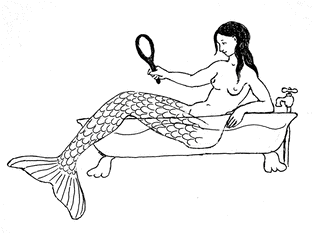
A Mermaid in the Bath* there are a number of footnotes and they are there for humorous effect. Therefore they need to be close to the text to which they refer. The solution that I have come up with is to put the footnotes in square brackets and in a slightly smaller font size immediately below the text which refers to them, and denoted with an asterisk as shown here.
[* A Mermaid in the Bath, a humorous philosophical novel and love story by Milton Marmalade, available from Amazon worldwide.]
Additionally, footnotes could be indented, although I have not done this. (The Kindle version of
A Mermaid in the Bath will be available soon.)
I should be interested in any comments on this or any other topic related to Kindle and e-reader formatting.