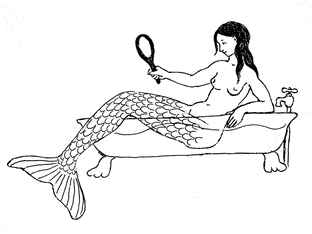
Showing posts with label A Mermaid in the Bath. Show all posts

Monday, 19 February 2018

The mermaid frontispiece for Sir Henry Herring's account of St Doris Island

Mermaid at St Doris Island, showing Drake's Golden Hinde, flying fish and a sea monster

The print is now available! Read on to see it.

You may remember the above sketch by Martin Dace for the frontispiece of Sir Henry Herring's book, 'Seynt Doris Ilande,' subtitled 'Seynt Doris, an Iland in ye Westerne Indies, its Historie Geographie & divers Marvells founde therein together with a Description of its Aboriginall Salvages, set down in all Veritie by Henry Herring, Earl of a Bit of Cornwall and not the Other Bit, who went with Francis Drake, Kt. in the XXI year of the reine of Her Glorious Majestie Queen Elizabeth whom God preserve. Printed and sold at St. Doris-by-the-Fishmonger Churchyard, London MDLXXXXIX.'

(Takes breath.)

The sketch is of course an attempt at a modern reconstruction of the original. I have the book somewhere but unfortunately it is in a box or perhaps a cupboard somewhere, and as frequently happens with things I put in a safe place I've no idea how to find it. Martin did the sketch from the description in my novel, 'A Mermaid in the Bath,' as follows:

'The frontispiece facing the title page showed a woodcut, primitive and wonderful, of a volcanic island fringed with palm trees, in the distance a little ship much like Drake's Golden Hinde and dominating the foreground a triumphantly naked mermaid.'

I am happy to report that not only is this pretty close to my memory of the original, but also that it has now been fully realised as a lino print. Here it is:

The mermaid at St Doris Island, together with Drake's Golden Hinde , a sea monster and four flying fish

This is now available as a limited edition print on Japanese Kitakata paper (buff coloured) or Shoji (white) from Martin Dace's Etsy store.

Thursday, 9 November 2017

Mermaid at St Doris Island - work in progress

Mermaid at St Doris Island - work in progress
Here is the current state of the latest mermaid linocut. Apart from a few wavy wiggles the sky will be more-or-less white. In the background you can see the volcano on St Doris Island and on the other side is Drake's Golden Hinde at anchor, as described in Sir Henry Herring's book, S. Doris Iland and the Divers Marvells therein, as quoted in A Mermaid in the Bath by Milton Marmalade.

Saturday, 16 September 2017

Jane Austen on the banknotes, as predicted by Milton Marmalade


As predicted on page 198 of my magnum opus, A Mermaid in the Bath, as of 14th September there will be a picture of Jane Austen on the ten pound note.

This is a further demonstration of the inspired nature of my oeuvre.

From page 198 of the paperback edition:

...Half way through Milton addresses himself to you with the words ‘gentle reader... .’ Who does he think he is, Jane Austen? Anyway I hope they put her picture on the banknotes as it’s about time we had a woman on there. Mind you the Queen is on all of them isn’t she? Talking of Jane Austen, that would have been a good name for a car in the heyday of the British Motor Corporation, instead of the Austin Cambridge, like. Then the Morris Oxford would have been Jane Morris. As you no doubt know, Jane Morris was the muse of the Pre-Raphaelites. It must be nice being a muse and getting all that male attention.

Goodness, this Argentine wine is good! I’m feeling quite inspired now. Perhaps I’ll write that bodice-ripper myself and then I can ask Milton to help me with it while I snuggle up to him. Once I’m back in England. And I’m not living in a shed at the back of the Co-op. He’ll have to get a proper house.

Thursday, 1 June 2017

A Mermaid in the Bath is now available in Kindle format!

Well this took a while! There are books out there that tell you that you can convert your word-processor files into e-books in an hour. But it takes a lot longer than that if you care about the look and feel of the result.

While an e-book can never quite match the experience of having a real book in your hands, I have done my best to put into the Kindle version the little images that are scattered between sections of A Mermaid in the Bath, including mermaids, starfish, jellyfish, an evil-looking squid and the wonderful union-jack underpants. The lovely mermaid facing the title page I had to leave out because Amazon charges authors by the kilobyte for the so-called download fee. Even so a smaller version of the sleeping mermaid is still to be found in chapter 44.

Ah me! Because of the download fee I had to reduce all the images to the minimum file size possible without losing too much quality. Current e-readers will not support the 600 dots per inch that print allows in any case. That's why it all took a long time.

Anyway, it's a work of art and it's a bargain at less than the price of a cup of coffee.

Thursday, 27 April 2017

Footnotes and end-notes in the Kindle and other e-readers

About footnotes*

[* and a man with three testicles]

When I am reading a printed book I actually read the footnotes (and I shall explain why you might also want to). If there are end-notes I keep an extra bookmark in the end-notes section (ok, I'm a geek). But doing this in a Kindle is not easy. This is one reason why e-reader formatting needs to be re-thought.

You may be one of those people who never read footnotes or end-notes, so you will not see a problem here. In a moment I shall try to persuade you otherwise (I shall explain about the man with three testicles and what the Pope did about it). But the main point of this article is to question some of the assumptions about book layout in e-readers. Simply transporting a book text unmodified into an e-reader such as the Kindle does not always translate into a good reader experience. This is particularly the case with footnotes and end-notes.

Footnotes, properly used, are there to enhance the reader experience while not interrupting the flow of text. Uses include explaining an obscure reference or phrase with which the reader might not be familiar, or adding an illuminating anecdote that is not a proper part of the text. In Bailey and Love's Physical Signs in Clinical Surgery there is a section describing the harmless swelling called a spermatocele that can arise in a man's scrotum. This can resemble a third testicle. That's all you really need to know. But a footnote adds, "The story goes that, in the 14th century, on petition from a patient with a spermatocele, the Pope granted a gentleman to marry two wives because he had three testicles."*

[*Also in Bailey and Love's Short Practice of Surgery p.1383.]

 The anecdote is not strictly necessary, but it is memorable. I would point out that Bailey and Love do not reference the source of the anecdote, so they may have made it up or copied it from someone else who made it up. If they had referenced it properly they could have put the reference in with the footnote. Perhaps Dan Brown can go and look for it in the Vatican archives, or perhaps it's just a rumour in Piers Plowman.*

[*I've no idea.]

While I am not aware of any strict rules, it seems to me that end-notes are more appropriate where it is less likely that the reader will want to look them up straight away. For example, there may be repeated quotations from a particular source, and you might want to look up the original for context ("A wonderful evening" - Groucho Marx; original quotation: "I've had a wonderful evening, and this wasn't it"), or because you feel inspired by what has been quoted and you want to go right out and buy the book.

With Kindle books, footnotes are more-or-less impossible. This is because the text flows across the screen according to the precise model of Kindle that you have and the size of type you have set as default, and so there is no guarantee that a footnote will appear at the bottom of the screen or even on the same page. In future this ought to be fixable, because if you highlight a word the definition will come up automatically at the bottom of the screen in what is in effect a pop-up footnote. But I know of no way that an author can exploit this. In any event, footnotes are generally translated into end-notes, which are fiddly.

I can move the cursor down to the end-note number (the little superscript number that denotes that there is an end-note) and click on the end-note link and sometimes it will take me to the end-note, and then I can click again and sometimes it will take me back. Not only is this tedious, it is also not reliable. Some writers and publishers do not bother to make their end-notes work, so you click and nothing happens.

In A Mermaid in the Bath* there are a number of footnotes and they are there for humorous effect. Therefore they need to be close to the text to which they refer. The solution that I have come up with is to put the footnotes in square brackets and in a slightly smaller font size immediately below the text which refers to them, and denoted with an asterisk as shown here.

[* A Mermaid in the Bath, a humorous philosophical novel and love story by Milton Marmalade, available from Amazon worldwide.]

Additionally, footnotes could be indented, although I have not done this. (The Kindle version of A Mermaid in the Bath will be available soon.)

I should be interested in any comments on this or any other topic related to Kindle and e-reader formatting.

Friday, 24 February 2017

Where do we go from here?

A rather serious meditation on what is, after all, intended to be a funny book. Lionel's quest in 'A Mermaid in the Bath.'

Do I live in a dream?

Yes, because I live in my head, or at least, I am not for the most part aware of my own existence. Yet as soon as I think about it, immediately I am aware of my body, these hands typing these words.

Or if I am driving, my mind can be away with whatever is on the car radio while my hands, feet and senses drive the car, perfectly safely, on autopilot, correctly stopping at red lights, anticipating and avoiding hazards and so on.

To be aware of the body driving is an interesting and even enjoyable experience. The mind does not need to interfere -- indeed it is too slow -- but it can watch. One can become aware (without looking) of one's hands on the steering wheel and also, somehow, of the traction of the wheels on the road. It helps to turn off the radio.

Touch-typing is a similarly odd experience -- to trust the fingers to find the correct keys, which inexplicably they do.

One learns to watch oneself doing all kinds of things.

Then on top of all this there are the complications of life, any life in which one takes some responsibility for the choices one has made, taking what is not so pleasant along with what is pleasant, because avoiding the unpleasant consequences of what one is, is to become a kind of tramp, barely to live at all. On the other hand, to live responsibly is to live fully, gradually to become free of little me.

That, I suppose, is what happens to Lionel in 'A Mermaid in the Bath.' The mermaid becomes his heart's desire, so he has to make the payment of leaving behind the safety of his previous self, and he has to do this with no certainty of success.

Yes, that is the other element: one's heart's desire.

Still, I believe in happy endings.


Monday, 1 August 2016

A Mermaid in the Bath: a new novel by Milton Marmalade - available now

A mermaid turns up in your bath, without explanation or warning—what do you do? It's almost as disruptive as the search for Truth or (worse) finding it. To complicate matters further, Lionel falls in love with her just before she disappears into the clutches of the evil Dr Squidtentacles.


This is a ripping yarn with some very slow car chases involving a Morris Minor and a slow ping-pong duel Matrix-style, not to mention (but I will anyway) a Greek chorus of Cornish villagers, an atomic submarine and a description of the mythical St Doris Island and what took place there in the reign of Queen Elizabeth I.

Between chapters of adventure not a lot more absurd than real life are philosophical ponderings by Professor Neville Twistytrouser of St Doris College, Oxford together with testy rebuttals by Professor Alphonse Pince-Nez of the department of Saltimbanques de Mer at the Sorbonne, not to mention (but I have, haven't I?) the fully justified complaints of Milton Marmalade's exotic Welsh secretary, Myfanwy.

Milton Marmalade's novel A Mermaid in the Bath is available now.

'Destined to become a cult classic.'

Milton Marmalade—'An idiot at the height of his powers.'