Thursday, 1 June 2017

A Mermaid in the Bath is now available in Kindle format!

Well this took a while! There are books out there that tell you that you can convert your word-processor files into e-books in an hour. But it takes a lot longer than that if you care about the look and feel of the result.

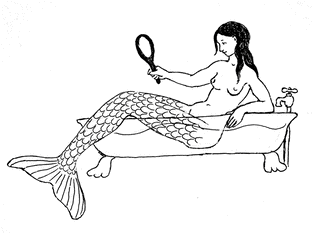
While an e-book can never quite match the experience of having a real book in your hands, I have done my best to put into the Kindle version the little images that are scattered between sections of A Mermaid in the Bath, including mermaids, starfish, jellyfish, an evil-looking squid and the wonderful union-jack underpants. The lovely mermaid facing the title page I had to leave out because Amazon charges authors by the kilobyte for the so-called download fee. Even so a smaller version of the sleeping mermaid is still to be found in chapter 44.

Ah me! Because of the download fee I had to reduce all the images to the minimum file size possible without losing too much quality. Current e-readers will not support the 600 dots per inch that print allows in any case. That's why it all took a long time.

Anyway, it's a work of art and it's a bargain at less than the price of a cup of coffee.

Friday, 26 May 2017

I believe in the religion of love


(This Ibn Arabi quotation was found here.)

How can anyone believe in a God of hate? But as Hannah Arendt pointed out, evil is banal. It is a failure to think and to understand. It is the mindless acceptance of whatever rubbish someone else has said, or the mindless misinterpretation of scripture. Think, question, and don't trust your own conclusions.


Thursday, 11 May 2017

Innocent faith

Clever atheists sometimes mock the faith of the faithful. I used to do the same. But there is an obtuseness about the mocking.


If I may plead in my own defence, it was because I was looking for the door and no-one seemed able to show me the door. The myths by which religions live were opaque to me. The myths are the door, but without the key the door is a wall.

Some denied there was a door at all let alone a key. Specifically, in my youth I would ask, 'what is the meaning of life?' and I was told that the question was naive. Probably I'd grow out of it. At the same time I didn't see how the Virgin Birth or even Hanuman and his army of monkeys could help me. Are these not stories for children?

Again, some of the faithful claim that their version of the truth is the only correct one, the only path to Paradise. How should one choose? Choosing on the basis of ones parents' belief seemed to me rather arbitrary. Surely one should choose what is right, not necessarily what is habitual? Given that my revered primary school teacher was a Spiritualist (who believed her dog was the reincarnation of her previous dog, but had the clarity of mind to explain to us children that not everyone believes as she does, and that there are other points of view), my father flit between the Quakers, the Roman Catholic Church and some kind of misunderstanding of Buddhism, and my mother became a born-again atheist, I did not have a clear route to follow.

I cannot resist putting in a little anecdote told to me by a Bahá'í: someone was travelling through some part of the USA and passed a sign saying The Church of God. A little further down the road was another sign, reading The One True Church of God. Later they passed a third sign reading The One and Only True Church of God. Now clearly they cannot all be the only true church, and the philosopher Bertrand Russell would have pointed out that asserting that something is true does not add one iota to its truth value ('P is true' means exactly the same as 'P', where P is a proposition).

There is a problem with belief and it is this: a clever atheist can always come along and point out that parthenogenesis is recorded among some animals but not among humans, or that a reporter from the Daily Mail was not present at the Annunciation (not that that would have made the events any more plausible), or that no-one has ever been seen with blue skin (and I certainly mean no disrespect - dancing with all the cow-girls is one of the most delightful stories in all religion). How do we address this?

It seems to me likely that there is a door and there is a key. I cannot prove this, but without this assumption there is no point in even starting. This assumption has been made by the best minds since the dawn of history and probably before. The world is full of it and civilisations have been built on it. Correctly understood, the similarities between the faiths and the wise are there to see, although clothed in different styles and with different myths. A myth is simply a story, in this context a story that contains a truth. A truth that cannot be expressed better any other way.

Everyone needs a story to live by. Carlos Castaneda refers to 'a path with heart.' As we live and learn, perhaps the way we describe our path becomes less naive, we put away childish things (1 Corinthians 13:11). Meanwhile, a childish faith is a path with heart.

He who mocks the infant's faith
Shall be mock'd in age and death.
He who shall teach the child to doubt
The rotting grave shall ne'er get out.

He who respects the infant's faith
Triumphs over hell and death.
The child's toys and the old man's reasons
Are the fruits of the two seasons.

- William Blake, from Auguries of Innocence

Thursday, 27 April 2017

Footnotes and end-notes in the Kindle and other e-readers

About footnotes*

[* and a man with three testicles]

When I am reading a printed book I actually read the footnotes (and I shall explain why you might also want to). If there are end-notes I keep an extra bookmark in the end-notes section (ok, I'm a geek). But doing this in a Kindle is not easy. This is one reason why e-reader formatting needs to be re-thought.

You may be one of those people who never read footnotes or end-notes, so you will not see a problem here. In a moment I shall try to persuade you otherwise (I shall explain about the man with three testicles and what the Pope did about it). But the main point of this article is to question some of the assumptions about book layout in e-readers. Simply transporting a book text unmodified into an e-reader such as the Kindle does not always translate into a good reader experience. This is particularly the case with footnotes and end-notes.

Footnotes, properly used, are there to enhance the reader experience while not interrupting the flow of text. Uses include explaining an obscure reference or phrase with which the reader might not be familiar, or adding an illuminating anecdote that is not a proper part of the text. In Bailey and Love's Physical Signs in Clinical Surgery there is a section describing the harmless swelling called a spermatocele that can arise in a man's scrotum. This can resemble a third testicle. That's all you really need to know. But a footnote adds, "The story goes that, in the 14th century, on petition from a patient with a spermatocele, the Pope granted a gentleman to marry two wives because he had three testicles."*

[*Also in Bailey and Love's Short Practice of Surgery p.1383.]

 The anecdote is not strictly necessary, but it is memorable. I would point out that Bailey and Love do not reference the source of the anecdote, so they may have made it up or copied it from someone else who made it up. If they had referenced it properly they could have put the reference in with the footnote. Perhaps Dan Brown can go and look for it in the Vatican archives, or perhaps it's just a rumour in Piers Plowman.*

[*I've no idea.]

While I am not aware of any strict rules, it seems to me that end-notes are more appropriate where it is less likely that the reader will want to look them up straight away. For example, there may be repeated quotations from a particular source, and you might want to look up the original for context ("A wonderful evening" - Groucho Marx; original quotation: "I've had a wonderful evening, and this wasn't it"), or because you feel inspired by what has been quoted and you want to go right out and buy the book.

With Kindle books, footnotes are more-or-less impossible. This is because the text flows across the screen according to the precise model of Kindle that you have and the size of type you have set as default, and so there is no guarantee that a footnote will appear at the bottom of the screen or even on the same page. In future this ought to be fixable, because if you highlight a word the definition will come up automatically at the bottom of the screen in what is in effect a pop-up footnote. But I know of no way that an author can exploit this. In any event, footnotes are generally translated into end-notes, which are fiddly.

I can move the cursor down to the end-note number (the little superscript number that denotes that there is an end-note) and click on the end-note link and sometimes it will take me to the end-note, and then I can click again and sometimes it will take me back. Not only is this tedious, it is also not reliable. Some writers and publishers do not bother to make their end-notes work, so you click and nothing happens.

In A Mermaid in the Bath* there are a number of footnotes and they are there for humorous effect. Therefore they need to be close to the text to which they refer. The solution that I have come up with is to put the footnotes in square brackets and in a slightly smaller font size immediately below the text which refers to them, and denoted with an asterisk as shown here.

[* A Mermaid in the Bath, a humorous philosophical novel and love story by Milton Marmalade, available from Amazon worldwide.]

Additionally, footnotes could be indented, although I have not done this. (The Kindle version of A Mermaid in the Bath will be available soon.)

I should be interested in any comments on this or any other topic related to Kindle and e-reader formatting.

Thursday, 20 April 2017

Every thing that is possible to be believed


If the believer understood the meaning of the saying 'the colour of the water is the colour of the receptacle', he would admit the validity of all beliefs and he would recognise God in every form and every object of faith. - Ibn 'Arabi (from The Meccan Revelations)


Every thing that is possible to be believed is an image of the truth. - William Blake

Thursday, 13 April 2017

On those who deny the existence of God

It is reasonable to deny the existence of God, if by 'God' you mean some being external to yourself who hangs around in the sky either interfering or not interfering in the creation (since either causes problems). Also, a god who is supposed to be the creator of everything begs a number of questions, such as 'who created God?'

If however we begin to look at the world from the bottom up, so to speak, we realise that the whole thing is a living mystery. Just being conscious is inexplicable. We can talk indefinitely about neural networks and emergent properties, and still not understand how I, now, can be conscious, or even why the consciousness that contains me seems not to be the same as the consciousness that contains you (why am I me and not you?). (This is a question that has perplexed me since I was five years old and my toy rabbit was confiscated in school and put on a shelf where I could see it and not get it. I remember thinking, why am I me and not that toy rabbit? Of course I now understand that cloth animals are not made in such a way that they can be conscious, at least it is reasonable to suppose so, but the question 'why me here now?' remains.)

The question becomes less or more confusing (depending on our point of view) if we start to look at it from a god-like perspective, as it were from the outside, as if we could see the whole creation, and imagine creating beings such as ourselves wired up in such a way that we can exhibit complex behaviours. Then we can say, well, that one thinks it's conscious because that's how it's made, and so does that one and those over there. No mystery really. But actually we are only privy to a god-like perspective in our imaginations - that's not how it is.

Then again, if God exists it follows that God is more than our human understanding, and therefore we should not expect to be able to reason about God, except to say that logically it follows that we cannot reason about God.

Why have what the atheists would call an unnecessary hypothesis? Let us go with Hippocrates and ask for no unnecessary hypothesis. Then if we glimpse something more than the imaginary world in which we say we live we can allow space for what we don't know.

From Robert Graves's poem Warning to Children:

"Children, if you dare to think
Of the greatness, rareness, muchness
Fewness of this precious only
Endless world in which you say
You live, you think of things like this: ..."

Thursday, 6 April 2017

God rewards fools

Quotation abbreviated from that quoted in Out of the Labyrinth - setting mathematics free by Kaplan and Kaplan - the quotation is from Martin Hellman, one of the inventors of public key cryptography:

"... the way to get to the top [...] is to be a fool, because only fools keep trying. [...] Unless you're foolish enough to be continually excited, you won't have the motivation, you won't have the energy to carry it through. God rewards fools." (p.29)